2016 books: 27-32
Sep. 2nd, 2016 02:53 pm![[personal profile]](https://www.dreamwidth.org/img/silk/identity/user.png) the_siobhan
the_siobhanOne of the things I should probably be more clear about is that BookBub doesn't just have links to self-published authors, I just tend to download those ones because they are free. They link to tons of sales on better known authors who have stuff on sale - I have seen Neil Gaiman and Neal Stephenson both featured.
Also, shout-out to![[livejournal.com profile]](https://www.dreamwidth.org/img/external/lj-userinfo.gif) iamjw for posting that Tor.com is offering a free e-book every month if you sign up on their site.
iamjw for posting that Tor.com is offering a free e-book every month if you sign up on their site.
The story is fascinating, even though I don't think a lot of plot actually happens. It's told from three separate viewpoints - a woman who is brought to the city as an adult, one of the children who grows up there, and Apollo's. It's the story of a group of people attempting to create a Utopian society and struggling with their own fallibility as well as the flaws in Plato's vision.
So this is the first book in a Trilogy, and although I loved her writing I'm not sure that I want to read more in this particular universe. It does make me want to check out what she does in other settings.
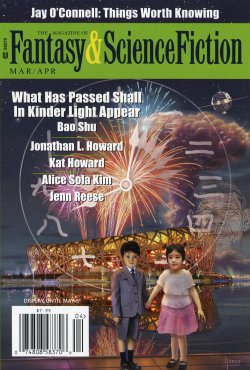
Fantasy & Science Fiction Mar/Apr 2015 and May/Jun 2016.
I have these because a friend has a story published in each one, and she generously gave us a copy. I'm counting them each as a book because I figure there's as much material in here as you would find in your average short story collection.
I'll give this magazine credit, they do a fantastic job of presenting a wide variety of themes and styles. There were a few that were well done but not particularly to my tastes - I think stories that are basically a series of computer readouts are kind of overdone by now, just as an example - but there were also some writers I liked enough to want to check out more of their stuff.
And my friend's writing is great, which pisses me off and makes me want to quit this writing lark entirely.
This book was incredibly engrossing, in large part because it never seems to do things the way I expect. I found the dialogue a little choppy just because it was translated from Chinese, and obviously I'm going to lack the cultural context for how things are phrased. I also found it weird that so little attention was paid to some pretty fantastic biology, especially given how much focus was given to explaining why the physics was plausible. But really those end up being trivial details. I can't really give you any more of the plot just because it is just too weird. But in a good way.
The plot follows a doctor who was involved in the cure research and who is currently providing psychiatric evaluations for the court case of the people who have been charged in the bacteria's release. Only in the process of getting to the bottom of what really happened all those years ago she figures out that maybe the Plague is still an active danger.
I really like the premise because it doesn't dwell on the initial zombie fighting, but on the aftermath and recovery, which I think is a much more interesting story. I also thought the world-building was well done. The personal relationship scenes with the protagonist I thought were terrible, but they took up only a small amount of the story and the rest of the writing wasn't bad at all. I ended up really enjoying the story.
I think my experiment in reading all these books has given me a better sense of the difference between writing that is perfectly adequate and writing that is really good. (Bad writing is always a lot more obvious.)
I figure I'm pretty solidly in the "adequate" band. I just have to figure out what tools I need to jump that gap.
Also, shout-out to
iamjw for posting that Tor.com is offering a free e-book every month if you sign up on their site. The Just City by Jo Walton This was Tor.com's featured book in August, and I managed to grab it just before the deadline. I've heard so many good things about her writing and I've been meaning to check her stuff out for a while. This book was really not what I was expecting. (I'm not sure what I was expecting.) The Goddess Athena decides to conduct an experiment by creating a city based on Plato's The Republic. Adults and children are brought there from various time periods. The adults are people who prayed to Athena, (mostly women who lived during time periods where the thought of women getting an equal education was revolutionary) and the children are slaves sold in the local markets. All are returned to their own timeline at the moment of their death and the city itself is built on a volcanic island so that all evidence will be destroyed and it won't change history. Her brother Apollo decides to incarnate as one of the children brought to the city. |
The story is fascinating, even though I don't think a lot of plot actually happens. It's told from three separate viewpoints - a woman who is brought to the city as an adult, one of the children who grows up there, and Apollo's. It's the story of a group of people attempting to create a Utopian society and struggling with their own fallibility as well as the flaws in Plato's vision.
So this is the first book in a Trilogy, and although I loved her writing I'm not sure that I want to read more in this particular universe. It does make me want to check out what she does in other settings.
 |
 |
Fantasy & Science Fiction Mar/Apr 2015 and May/Jun 2016.
I have these because a friend has a story published in each one, and she generously gave us a copy. I'm counting them each as a book because I figure there's as much material in here as you would find in your average short story collection.
I'll give this magazine credit, they do a fantastic job of presenting a wide variety of themes and styles. There were a few that were well done but not particularly to my tastes - I think stories that are basically a series of computer readouts are kind of overdone by now, just as an example - but there were also some writers I liked enough to want to check out more of their stuff.
And my friend's writing is great, which pisses me off and makes me want to quit this writing lark entirely.
The Three-Body Problem by Cixin Liu Wow, this book. I don't even know where to start. There is a lot of physics in this book. In fact most of the major characters are physicists or mathematicians. The story starts with a young woman during the Cultural Revolution who sees her father killed, witnesses environmental devastation during one of her work assignments and experiences personal betrayal at the hands of somebody she thinks is an ally. This leads her to believe that humans are essentially an irredeemably horrible species who can't be trusted to guide our own fate. Then the story flips to the present day. A physicist working on nano-tech is brought into an investigation of why the world's major scientific minds are suddenly committing suicide. |
This book was incredibly engrossing, in large part because it never seems to do things the way I expect. I found the dialogue a little choppy just because it was translated from Chinese, and obviously I'm going to lack the cultural context for how things are phrased. I also found it weird that so little attention was paid to some pretty fantastic biology, especially given how much focus was given to explaining why the physics was plausible. But really those end up being trivial details. I can't really give you any more of the plot just because it is just too weird. But in a good way.
 |
After the Cure by Deirdre Gould I think this is a self-published book as well. Gould's home base on the web is at a site called Scullery Tales, but I get the impression it's a group site for a bunch of writers who don't want to have to maintain their own individual sites, rather than an actual publisher. Anyway. The premise of this book that the zombie apocalypse happened eight years ago due to an antibiotic-resistant bacteria created in a lab that mutates and escapes. A cure is eventually found and the infected recover and remember everything they did. Society is a shambles, suicide rates are over 30% among the cured (and not much lower among the immune) and large parts of the world are still infected. Recovery is slow just because the population has gone through a massive crash and there aren't a lot of people left to do the necessary work, plus every single person left alive is pretty much a walking case of PTSD. |
The plot follows a doctor who was involved in the cure research and who is currently providing psychiatric evaluations for the court case of the people who have been charged in the bacteria's release. Only in the process of getting to the bottom of what really happened all those years ago she figures out that maybe the Plague is still an active danger.
I really like the premise because it doesn't dwell on the initial zombie fighting, but on the aftermath and recovery, which I think is a much more interesting story. I also thought the world-building was well done. The personal relationship scenes with the protagonist I thought were terrible, but they took up only a small amount of the story and the rest of the writing wasn't bad at all. I ended up really enjoying the story.
I think my experiment in reading all these books has given me a better sense of the difference between writing that is perfectly adequate and writing that is really good. (Bad writing is always a lot more obvious.)
I figure I'm pretty solidly in the "adequate" band. I just have to figure out what tools I need to jump that gap.
(no subject)
Date: 2016-09-03 12:10 pm (UTC)Also, icon love!
(no subject)
Date: 2016-09-09 11:45 am (UTC)I've heard so many good things. I'll see the movie though, (in part because I have heard that this is the first book of a trilogy, and the second book has a different translator, and they're apparently shit at it, compared to the person who translated the first and third books).
I have a book of Cixin Liu's (wait... that name seems wrong, I may need to check this because I am thinking Ted Chang, but far too busy to google) short stories wish-listed, but it's been out of stock for some time.
Who's your friend in SF&F?
(no subject)
Date: 2016-09-09 01:17 pm (UTC)(no subject)
Date: 2016-09-09 10:24 pm (UTC)Good for her livin' the dream.