2013 Books: 3-5
Feb. 6th, 2013 01:02 pm![[personal profile]](https://www.dreamwidth.org/img/silk/identity/user.png) the_siobhan
the_siobhanSo I took Jola's advice and put down the Eddison until I've read Oroboros. Which may or may not be here. We're still working our way through the boxes.

So the next book I read was The Science Fiction Hall Of Fame Volume 2b Which was actually kind of fun. Apparently this was part of a collection of the best stories published before 1966. "Best" as voted for by the members of the Science Fiction Writers of America, and published before 1966 because that made them ineligable for a Nebula award, which was established in 1965.
Anyway, there was a great variety of voice and style, it was a nice counterpoint to all the Niven I had been reading, and when I finished it I figured end on a high note and put down the SF for a little while.
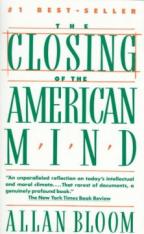
Closing of the American Mind by Allan Bloom.
I have no idea why I have this book.
But have it I do. It has my name in it and everything.
An alternate title could have been, "Kids These Days". The author was a liberal arts prof at an ivy-league college teaching wealthy privileged kids and talking about how America is going to hell in a handbasket. From what I could decipher from the first few chapters (and prying any kind of actual point out of this barrage of florid name-dropping was like a root canal);
I leafed ahead out of morbid curiosity and found the passage where he says he hears some woman on a radio show claiming that men want to keep women out of combat roles soley out of paternalism. The author thinks this is a positive thing because the urge to protect is the urge towards unselfishness and is a virtue, therfore to be encouraged. Half the human race should totally be in favour of putting their careers on hold so that the other half can experience virtues. I gave up at that point.
So in summary, "Old white guy finds himself increasingly irrelevent, writes a book about it." Axel suggested throwing it right in the recycling bin but I left it on the give-away bookcase on that chance any other masochists want to wade through it.

Taking the Quantum Leap by Fred Alan Wolf. I have no idea why I have this book either, (man, I was some kind of written word sponge in the 80s) but I'm glad I do. Turns out Prof Wolf is a theoretical physicist "specializing in quantum physics and the relationship between physics and consciousness". How freaking cool is that? Of course he doesn't have a "real" education, but he does talk about Aristotle, so maybe he counts as half-educated.
Anyway he has a side-line in explaning what he does to non-mathematicians. This particular book traces the history of the physics of movement in very simple layman's terms with lots of non-threatening line drawings and photos and a few Pink Floyd quotes. So far I'm up to Max Plancke. It makes me want to read more of his books, even if only to spite Bloom.
So the next book I read was The Science Fiction Hall Of Fame Volume 2b Which was actually kind of fun. Apparently this was part of a collection of the best stories published before 1966. "Best" as voted for by the members of the Science Fiction Writers of America, and published before 1966 because that made them ineligable for a Nebula award, which was established in 1965.
Anyway, there was a great variety of voice and style, it was a nice counterpoint to all the Niven I had been reading, and when I finished it I figured end on a high note and put down the SF for a little while.
Closing of the American Mind by Allan Bloom.
I have no idea why I have this book.
But have it I do. It has my name in it and everything.
An alternate title could have been, "Kids These Days". The author was a liberal arts prof at an ivy-league college teaching wealthy privileged kids and talking about how America is going to hell in a handbasket. From what I could decipher from the first few chapters (and prying any kind of actual point out of this barrage of florid name-dropping was like a root canal);
- Treating minorities as having their own value apart from the majority culture is bad because minorities should seek to merge with the majority American culture in working towards the greater good
- Feminism has devalued the Classics which is bad because the Classics provide a model that people should strive to emulate. He freely admits that the Classics are sexist though, so I guess modelling sexism is ok.
- Households that do not study "the Book" (by which I think he means the Bible) have kids without a moral compass
- Too many people have what they think is education, but it isn't really because what they have technical studies and not a liberal arts degree. This results in them thinking they have the right to opinions that are not directly influenced by Aristotle, which is bad. The world was therefore happier when people were uneducated, worked with their hands, and had more pure worldviews. From studying the Bible, I think.
- Kids like "rock music" and have become addicted to it's pleasures because it simulates masturbation. The only music of actual value is of course, classical music.
I leafed ahead out of morbid curiosity and found the passage where he says he hears some woman on a radio show claiming that men want to keep women out of combat roles soley out of paternalism. The author thinks this is a positive thing because the urge to protect is the urge towards unselfishness and is a virtue, therfore to be encouraged. Half the human race should totally be in favour of putting their careers on hold so that the other half can experience virtues. I gave up at that point.
So in summary, "Old white guy finds himself increasingly irrelevent, writes a book about it." Axel suggested throwing it right in the recycling bin but I left it on the give-away bookcase on that chance any other masochists want to wade through it.
Taking the Quantum Leap by Fred Alan Wolf. I have no idea why I have this book either, (man, I was some kind of written word sponge in the 80s) but I'm glad I do. Turns out Prof Wolf is a theoretical physicist "specializing in quantum physics and the relationship between physics and consciousness". How freaking cool is that? Of course he doesn't have a "real" education, but he does talk about Aristotle, so maybe he counts as half-educated.
Anyway he has a side-line in explaning what he does to non-mathematicians. This particular book traces the history of the physics of movement in very simple layman's terms with lots of non-threatening line drawings and photos and a few Pink Floyd quotes. So far I'm up to Max Plancke. It makes me want to read more of his books, even if only to spite Bloom.