2014 books: 52-59
Dec. 18th, 2014 10:38 am![[personal profile]](https://www.dreamwidth.org/img/silk/identity/user.png) the_siobhan
the_siobhan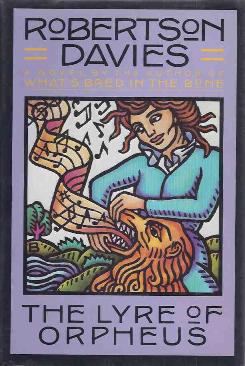 |
The Cornish Trilogy by Robertson Davies I've had The Lyre of Orpheus kicking around for years (1989 according to the note inside the cover) and I always figured I would get around to reading it when I got the other two books in the series. Axel downloaded the whole trilogy so I finally read them all. As it turns out the stories are independent but interrelated - I probably could have gotten away with just reading the one, but reading all three together gives the final book a lot more meat. The Rebel Angels is about a group of people associated with a fictional-but-not-really University in Toronto. The "Cornish" that gives his name to the trilogy is an art collector named Francis Cornish who has recently died and left his collection to various galleries and libraries. Three of the four main characters are the Professors he has named as his executors and a forth is the graduate student of one of the three. This is really a sub-plot that serves the drive the characters together while the main events focus on a former professor who is also a former friend and the brightest graduate of the philosophy department who ran off to wallow in debauchery for a couple of decades and has just returned to hit up everybody he knows for money and a place to stay. |
What's Bred In The Bone goes back in time and tells the story of Francis Cornish's life as a painter, spy, art critic and collector.
The The Lyre of Orpheus jumps back to the present. Francis Cornish's fortune has been used by his nephew Arthur Cornish to set up a Foundation dedicated to sponsoring the arts. They choose to fund the completion of an opera about King Arthur. All the characters of the first book (the ones who are still alive, at least) get their lives completely taken over by this opera. Meanwhile one of their group is also writing a book about Cornish's life and finding out about the whole spy thing, among a few other choice secrets.
If I had to drum up something negative about these books it would be that the language often feels very unnatural, almost archaic. The soliloquies in particular can feel artificial if the reader is used to the terseness of most post-Hemmingway writing. On the other hand, the way the characters are constantly bitching at each other feels very authentic. And on the third hand, since the characters are very much drawn larger than life; so it ends up seeming authentic to the story that in most cases they don't speak the same way as your average man-on-the-street.
That sounds like I didn't enjoy reading them, but I very much did. The writing is incredibly rich and layered. I ended up hoovering up all three books.
 |
Surfacing, Life Before Man and The Handmaid's Tale by Margaret Atwood Apparently I got this trilogy in 1990. It's an odd combo of stories and I wonder if her publishers weren't trying to drum up some interest in her earlier work outside of Canada by bundling a couple of her less well-known novels with her "hit". Surfacing takes place in the early 70s, which is reflected in descriptions of clothing and recent events. (She keeps referring to "the war" - understood to mean the US in Vietnam.) It opens with the main character returning to the remote cabin where she lived as a child, ostensibly to search for her father who has recently disappeared. She is accompanied by three people she calls her closest friends. She has known them for a few months. The lead character is alienated to the point of disassociation. Their isolation puts the four of them in a fishbowl so that every personality trait is magnified. Her friends are assholes, especially the men, and she becomes even more alienated over the course of the story, to the point of finally losing her sanity and abandoning her relationship with humanity. |
Life Before Man takes place a few years later in downtown Toronto. The focal point is a married couple named Elizabeth and Nate. They are no longer interested in their marriage or each other but they continue to live together so that they can both easily maintain their existing relationship with their children. They seek relationships with others for emotional fulfillment. At the opening of the story, both of them have just broken up with their lovers and Elizabeth's boyfriend has committed a very messy revenge suicide as a result.
I was talking to Axel about how fascinating I find this story because of it's superficial similarities with our lives. On the surface the arrangement is entirely civil and Elizabeth insists on establishing "friendships" with her husband's partners. In reality they play endless power games against each other and they roll through their lovers lives like bulldozers. By the end of the book I was really hoping that Nate's partner would finally tell them both to go fuck themselves and move on with her life.
The Handmaid's Tale is Atwood's best-known book, written in the mid-80s. Most people know the story; the US is taken over by religious extremists who enact laws that control every aspect of peoples' lives and turn women into chattel. It's seriously creepy reading it now. It was written decades before the Duggar family and the Quiverfull movement hit public consciousness. It feels even more like a prediction than it did when it was was written.
 |
 |
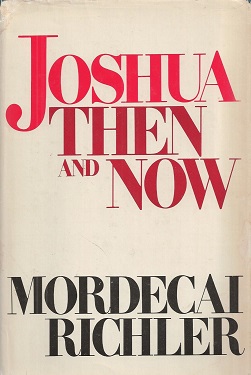
Joshua Then And Now and Barney's Version by Mordecai Richler
Apparently I bought Joshua Then And Now in 1982. Another Book of the Month purchase.
The story is about the life of a boy who grew up in the St Urbane neighbourhood of Montreal to become a well-known writer and television personality. It's obvious that Richler drew heavily on his own life growing up in the Jewish community in Montreal as the source material for a lot of the story.
The writing took a little getting used to because he jumps back and forth in time rather than telling the story in a linear way, but once I adjusted it's hilarious. In many ways it feels quite dated - apparently in 1980 a homosexual affair was still pretty scandalous business, and it seems incongruous that somebody who has a lengthy affair with a friend's wife can come across as so prissy about porn.
I've just started reading Barney's Version. The story starts when he is an old man reminiscing about his life. It could be about the same character, older and with the details of his history changed. The central event of the novel is the disappearance of his best friend. He was accused of murder and he maintains his innocence in spite of the fact that everybody thinks he did it.
Richler is a very Canadian writer in spite of the fact that the characters spend a lot of time in different locations. Montreal plays a central part of all his stories and he spends a lot of time banging on about sports. One of the things I find fascinating about his writing is how gritty everything feels - Atwood's characters always feel slightly disassociated. When I open a Richler book the scent of stale cigarette smoke and dirty feet all but wafts off the page.
I expect the last book to take me close to the end of the year, so I'm going to say 59 is my total. 6 books more than last year. This is another two shelves people!
By my estimate it will take me approximate 376 years to completely clear out the house.